


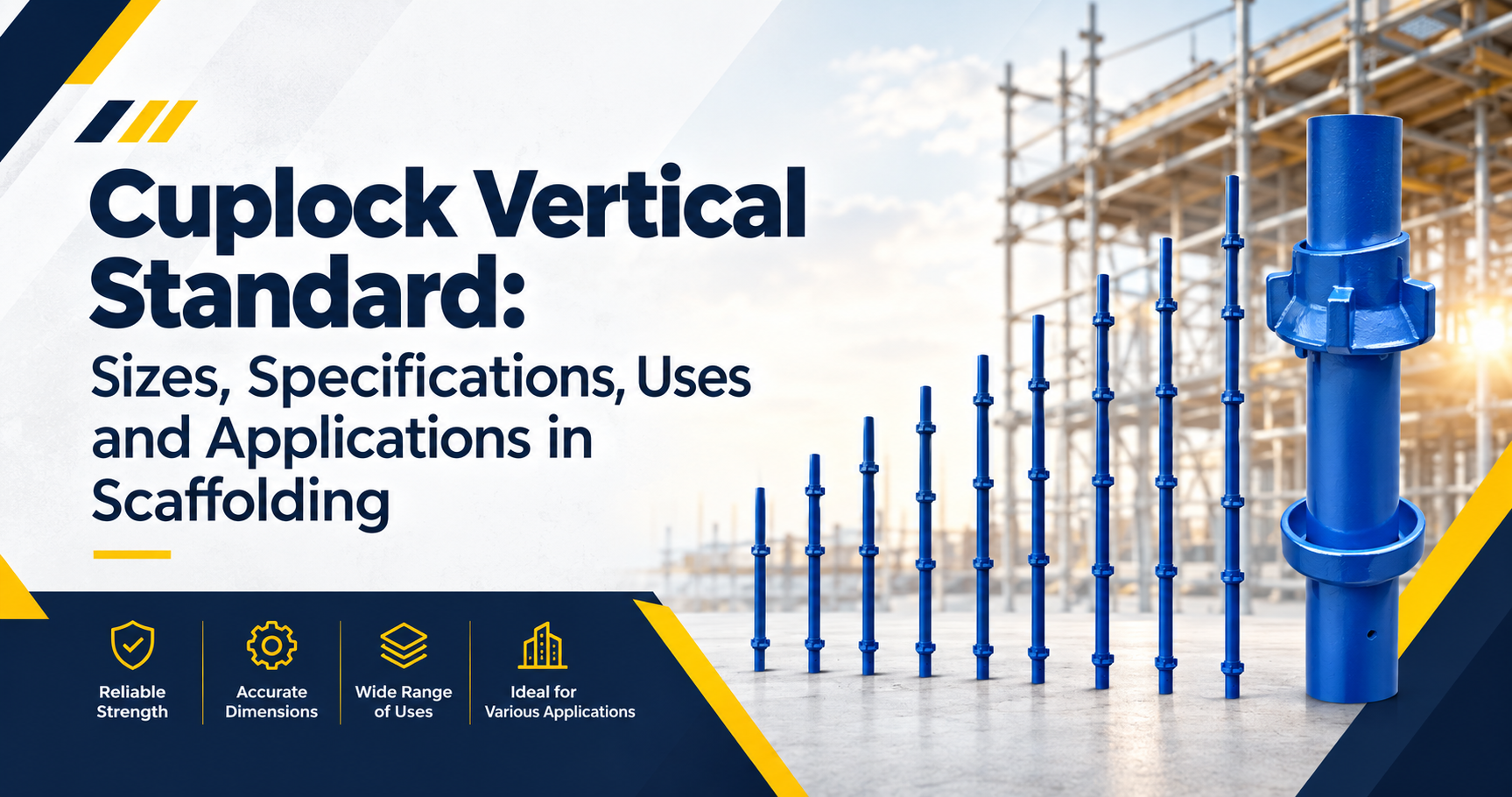
Scaffolding is very important in construction. It gives workers access and stable work platforms at various heights. I have seen Cuplock Vertical Standard used on construction sites. Among scaffolding systems cuplock scaffolding is popular. Cuplock scaffolding is strong, flexible and easy to put
Cuplock Vertical Standard is a part of this system. Cuplock Vertical Standard acts as the support. Cuplock Vertical Standard joins with ledgers and other parts to build a strong and stable structure.
-
What Is a Cuplock Vertical Standard?
A vertical standard is a steel rod that creates the framework of cuplock scaffolding. Cuplock Vertical Standard has special cup connections. These cup connections let horizontal ledgers attach at levels. I find the cup‑and‑blade connection very handy. The cup‑and‑blade design makes putting the system and taking it apart quicker. It also cuts down on fittings. Cuplock Vertical Standard is therefore useful for construction, maintenance, infrastructure and industrial projects.
-
Cuplock Standard Specifications
The size of a Cuplock Vertical Standard depends on how tall the scaffold's how it is designed. Many lengths of Cuplock Vertical Standard exist to fit projects. SteelSafe makes Cuplock Standard from ISI‑marked pipe. SteelSafe Cuplock Standard is made for construction work.
Key Specifications
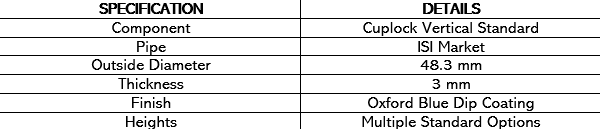
Choosing the length of Cuplock Vertical Standard depends on the needed scaffold height, platform levels how much weight it must carry and the overall design.
-
Uses and Applications
The cuplock vertical standard gives the upright support for the scaffolding. Cuplock Vertical Standard can be used for building construction, commercial and residential projects, industrial plants, bridge and infrastructure projects, repair and renovation work, painting and plastering, maintenance and elevated access and temporary work platforms. Cuplock Vertical Standard’s modular design lets the scaffolding be built to fit different site layouts and job needs.
-
Advantages of Cuplock Scaffolding
A built-in cuplock system has many advantages. Quick assembly is one because the cup‑and‑blade connection makes installation easier. Strong structure is another as quality steel parts give support. Flexible configuration helps, because parts can be set up for project needs. Fewer loose fittings, thanks to the built‑in connection system mean need for extra couplers. Reusable parts can be used again after inspection and maintenance. Cuplock Vertical Standard is also good for projects because its modular design fits construction and infrastructure work.
-
How to Select the Right Cuplock Standard
When picking a Cuplock Vertical Standard think about pipe diameter, thickness, material quality, how accurate the connections are, the surface finish, the needed height and whether it fits with scaffolding parts. I always check the connection accuracy. Also look at the scaffold design like how much load it will carry, bracing, foundation, ties, platforms and site conditions. Erecting and inspecting the scaffold should always be done by trained and capable people.
-
Why Choose SteelSafe?
SteelSafe makes and sells scaffolding for construction and industry. SteelSafe Cuplock Vertical Standard uses ISI‑marked pipe. It has a 48.3 mm, outside diameter 3 mm thickness and Oxford Blue dip coating. As a Cuplock Vertical Standard maker SteelSafe aims to give sturdy and steady parts for many projects. Buyers who need a Cuplock Vertical Standard supplier can think about product quality how often it is available how consistent the manufacturing is and what services are offered.
The Cuplock Vertical Standard is a part of any cuplock scaffolding system. It gives the framework that links ledgers and holds work platforms. Because Cuplock Vertical Standard is modular strong and versatile cuplock scaffolding works well for construction, industrial and infrastructure jobs. Picking parts and sticking to correct design, building and inspection steps helps keep the structure safe and efficient.